Latest: Singapore single mother awaits death row in Malaysia for drug trafficking. On the pretext of a business trip to China, Iqah was handed a suitcase containing heroin arranged by her Nigerian boyfriend and was arrested by Malaysian Immigration. A campaign is underway to raise funds for the appeal. To find out more, read

We have also heard that since Vui Kong's appeal started, there has been an unofficial stay of execution for all prisoners on death row in Changi Prison, pending the decision of the court on Yong's case. As the case has been dismissed by the Court of Appeal, we anticipate a Changi gallows bloodbath in a scale not seen since the Pulau Senang uprising in 1965 when 18 men were convicted of murder and hanged in a single Friday morning.

Singapore, which routinely persecute dissenters and critics, continue to hang young drug runners while at the same time work closely with Burmese military generals, and has invested billions in business ties with Burma, one of the biggest heroin manufacturing countries the world.

-----------------------------

If you know someone who's charged in a capital case, received the death sentence, or is on death row in Singapore and if you have have your side of the story to tell, contact us at sgdeathpenalty [at] gmail.com


Showing posts with label anti death penalty. Show all posts

Saturday, October 23, 2010

Young PAP: Vengeance killing is a human right


Picture 2
I have just read an editorial on the death penalty by YPAP member Mr Michael Rebaczonok-Padulo, entitled ‘WHAT ABOUT HUMAN RIGHTS FOR VICTIMS?‘ I suggest you read it; it is a piece that provokes a very strong response from me. Which is why I would now like to take this blog entry to write my rebuttals to his argument. I will be quoting excerpts of his piece (underlined emphasis mine), followed by my response.
While it is good and even noble that there are persons and groups concerned with the ongoing struggle for the full application of human rights, I find it shocking that the human rights of the victims of heinous crimes for which criminals are executed are not always given as much media attention.
This is the main thrust of Rebaczonok-Padulo’s piece: that the rights of the victims are neglected, while anti-death penalty advocates are spending precious time and resources championing the cause of the perpetrators. However, this is not simply skewed or misleading; it is downright untrue.

Unlike what the writer would like you to believe, being anti-death penalty and caring for the victims are not mutually exclusive. One can do both, which is why many – if not all – anti-death penalty campaigners support rehabilitation and counseling programs for both victims AND inmates. We believe that everyone should have the care and attention that they need, and that no one is completely irredeemable. By calling for the abolishment of the death penalty, we are NOT neglecting the victims.

This leads me to my second point about the Rebaczonok-Padulo’s thesis. He seems to be suggesting that if we abolish the death penalty, we are somehow depriving the victims of their human rights. In other words, revenge killing is a human right.
My question to him would be this: since when was killing a human being the RIGHT of another? How would the execution of one person be fitting with the human rights of another? Has the writer not heard of “two wrongs don’t make a right”?

Justice is not based upon “eye for an eye, tooth for a tooth”. This is why we don’t sexually violate rapists, or cut slashers, etc. We recognise that there are some acts that are cruel and barbaric, and have no place in justice. We draw the line and refuse to commit the cruel acts that might have been committed by the criminals before us, because we refuse to sink to their level of violence. So why would we be willing to sink to a murderer’s level and endorse the death penalty, which is nothing more than state-sanctioned murder?
Although the name of the website sounds biased (http://www.prodeathpenalty.com), the information found there is incredibly detailed and factual…
“Detailed” and “factual” does not mean that the website cannot still be biased. And it is precisely as biased as the name ‘Pro-Death Penalty’ sounds. At the end of the day, Pro-Death Penalty.com is trying to convince people that the death penalty is good and right, and should be kept. It is as subjective as the website Anti-Death Penalty.org (http://www.antideathpenalty.org/). It is up for the individual to read these two sites and acquaint themselves with the facts, and make up their own minds.
Sifting through all the information so painstakingly gathered was, for me, akin to watching episode after episode of the ‘Crime Investigation’ series on Cable TV, as I was shocked into disbelief at the extent to which human beings can become so utterly depraved and bestial.

A Texan death chamber. Image from NYTimes.
I am glad that the writer feels horror at the “depraved and bestial” acts of certain human beings. That response is only natural. But if the writer can feel such abhorrence of violence and murder, why then is he advocating execution? If he is shocked and repulsed by violent crimes, why is he all right with lethal injections, long drops, firing squads, electrocution and gas chambers (for these are all methods of state execution found around the world)?
I submit that once a person commits the most supreme act of violence against another of his fellow human beings in the form of murder, or accomplice to murder, then he himself ipso facto forfeits his own human rights at the moment in which he commits the crime. This of course assumes that he is not doing so in self-defence, or to defend loved ones or other innocents from wanton attacks by criminals, or to defend his country in times of war. This also assumes, of course, that there is positive forensic evidence and/or credible eyewitness testimony that proves conclusively that he is the perpetrator of the crime in question.
These assumptions are logical, of course, but in real life it can be incredibly difficult, perhaps even impossible, to be sure of anything 100%. This is why we see people being exonerated after being sentenced to death row, or worse, executed. This is why, no matter how hard we try, there are still miscarriages of justice and wrongful convictions. This is bad enough with prison sentences, but with the death penalty it is the height of injustice. The irreversible nature of the death penalty requires the justice system to be absolutely infallible. However, like any other institution controlled and run by Man, there is always the possibility of mistakes and errors of judgement. They might not be intentional, but with death penalty cases that doesn’t make the consequences any less acceptable.


Image from SusanKuklin.com

When I read the book No Choirboy: Murder, Violence and Teenagers on Death Row, I realised that inmates could land on death row because of a myriad of issues. Despite what we’d like to believe, real life is not like CSI, or Bones, or any of those homicide investigation TV dramas where they always have iron-clad proof and confessions with absolutely no sliver of a doubt about who the perpetrator is. People could land on death row because their accomplices cut deals or got plea bargains and testified against them. People could land on death row because of inadequate legal representation. People could land on death row because of a combination of seriously unfortunate circumstances. Even if you had the most upright cops, most diligent lawyers and most honest judges there would still be the possibility of errors.

So how could we just automatically strip a person of his human rights the moment we think he has committed a crime? How could we proclaim that a person does not deserve his/her human rights? How does that make us better people than they are?

And let’s go one further: what about the family of the offender? Do they, too, have to be punished just for being related to the offender?
So while some argue that Van Nguyen was not a murderer and, moreover, that he seemed to have fully repented while incarcerated, the fact remains that had he succeeded in his premeditated plan to sell the drugs, he would have been at least indirectly responsible for the possible destruction of the lives of those to whom the heroin would have been sold. That certainly ranks high on the list of very serious crimes, and one can hardly argue that it was carried out in the ‘heat of passion’.

Van Nguyen. Image from USP.co.au.
This argument about the death penalty for drug trafficking simply does not stand. What Rebaczonok-Padulo seems to be saying is that Van Nguyen deserved the death penalty because of the potential effects of the drugs he was carrying, not the actual damage done (which, since the drugs were confiscated at his arrest, was nil). If we follow this logic, we should also start handing out the death penalty for drunk driving, attempted murder, aggravated assault, domestic abuse, armed robbery, rioting etc. After all, any of those crimes have the potential of destroying lives.

It is not justice to mete out punishment – especially when the punishment is as cruel, archaic and irreversible as DEATH – on the grounds of potential harm. This is why Rebaczonok-Padulo’s argument here is, in a word, flawed.
Subsequently, however, the drug trade was sharply curtailed and crime dropped dramatically, thanks in part to capital punishment being meted out for such crimes, in his [Dr Lim Lee Ching] own view and that of his family. He logically associates the very strict laws governing crime and punishment with safe neighbourhoods, and is therefore in favour of retaining the death penalty, as are his family members.
This anecdote might very well be true in relation to the views and experience of the writer’s friend Dr Lim. However, it is insufficient as evidence of the effectiveness of the death penalty in curbing crime. When it comes to an issue as absolute, controversial and crucial as the death penalty, the burden of proof is heavy. Here Rebaczonok-Padulo does not provide any concrete evidence that the death penalty is the direct cause of reduction of crime – perhaps because there is no such evidence.

The argument that the death penalty is the cause of crime reduction also neglects other important factors such as police competence, rehabilitation of offenders and civic education. These are crucial factors in the fight against crime that should not be so easily pushed aside or forgotten in favour of making general and simplistic assumptions about the death penalty.

Also, it is worth emphasising that having no death penalty does NOT mean we have no punishment. Would long prison sentences/life imprisonment not serve as deterrents?
Obviously administration of the death penalty is something never to be taken lightly in any case, which is precisely why it is meted out so rarely.
If the death penalty is really meted out so rarely, why is it that Amnesty International’s estimates have put Singapore at the top of the list of executions per capita in the world?
However, if one is not planning to commit murder (or in the case of Singapore, traffic in illegal drugs above certain stipulated quantities), then one has nothing to worry about.
This too, is not completely accurate. If you take a look at the presumption clauses of the Misuse of Drugs Act, you will realise that when it comes to drug trafficking charges, the burden of proof ends up on the shoulders of the defendant. This means that instead of the usual “innocent until proven guilty”, we’re looking at a “guilty until proven innocent” scenario. How does one prove one’s innocence in such a situation, with all the presumptions heaped upon one’s head?


Tochi could not understand what was happening, and cried all the way to the gallows.

On top of these presumption clauses, drug trafficking over the stipulated quantities comes with the MANDATORY death penalty. This means that the judge has no discretion in considering mitigating circumstances and handing out sentences. Once you’re found guilty – remember presumption clauses! – you WILL be sentenced to death. Goodbye.

Just look at the case of Iwuchukwu Amara Tochi, a young man from Nigeria who came to Singapore with the hopes of being a footballer. Although his trial judge admitted that “there was no direct evidence that he knew the capsules contained diamorphine”, he was executed anyway.

So it’s not true that one has no need to worry about the death penalty in Singapore if one does not commit murder or traffic drugs. All it takes is for someone to slip something into your bag/pocket/suitcase while you’re on holiday; 15g of heroin ain’t exactly a big package.
Fortunately, an Internet search reveals that there are indeed such support groups…
Rebaczonok-Padulo concludes his editorial with a list of 3 victims’ support groups in America, praising them for having “got their priorities right”. By listing these groups (LOLAM, Families of Murder Victims and Survivors of Homicide) in the context of his article, he seems to be suggesting that if we advocate abolishment of the death penalty, we are somehow letting these people down, disrespecting and neglecting their human rights. Seeing these links in his article, an average reader would have the impression that these groups are pro-death penalty.

However, if you actually look at the website, none of them are actually advocating the death penalty. In fact, Loved Ones Left After Murder (LOLAM) even states that the family’s “religious convictions will not allow them to advocate capital punishment”. These groups are not about baying for blood, they are about supporting the people left behind, and lobbying the government for better crime prevention and legislation.
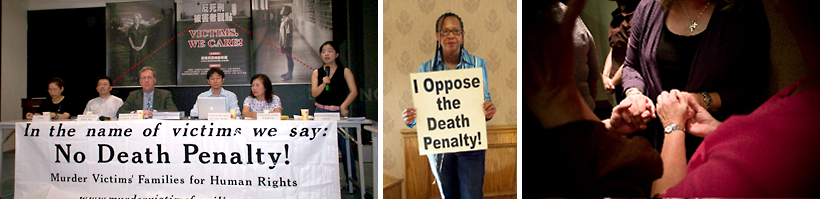

Image from MVFHR

In fact, there are a number of groups out there that both support the victims as well as campaign against the death penalty. Murder Victims’ Families for Reconciliation (MVFR) is one such example. Murder Victims’ Families for Human Rights (MVFHR) is another. In fact, you can find a whole list of literature, reports and organisations from victims against the death penalty here. The stories from these organisations are extraordinary tales of compassion, mercy and humanity.

This clearly proves that being anti-death penalty and caring for victims are not mutually exclusive standpoints. In fact, the above organisations have proven that one could even be a victim and still be anti-death penalty.
In summary, I find Rebaczonok-Padulo’s assumption that anti-death penalty advocates neglect the plight of the victims to be false. Contrary to his beliefs, one can support and sympathise with the victims while calling for the abolishment of capital punishment. Also contrary to his assertions, the abolishment of the death penalty is not an infringement of the human rights of victims. Two wrongs do not make a right. Death does not make things better; it only inflicts pain on yet another family.

I thank Mr Rebaczonok-Padulo for joining in the death penalty discussion and weighing in with his views on the YPAP website. I respect his right to his own view and standpoint, and would therefore ask him to extend the same courtesy to me and my fellow anti-death penalty campaigners, and thank him to not make such snap judgements or hasty generalisations about our priorities.

Sunday, October 3, 2010

Why so little data on hanging?

Why so little data on hanging?

Unless death penalty becomes a hot ideological issue, it is unlikely this will change


WHAT ends warrant a hanging at dawn?


Five years ago, the execution of Australian drug trafficker Nguyen Tuong Van, 25, sparked a debate over precisely that question. For a moment, at least, Singapore's mandatory death penalty for drug trafficking came up for discussion.

Today, the issue is back in the spotlight with the death sentence Yong Vui Kong, 22, a Malaysian convicted of the same offence, has received. Then, as now, a campaign has sprung up around the condemned, calling for clemency and second chances.

Yong's lawyer, Mr M. Ravi, has tried to save his client, for whom he is working free of charge. He has invoked Singapore's Constitution and involved the Malaysian government. The case is awaiting final appeal in the Court of Appeal.

It is easy to see why Nguyen and Yong have attracted such attention. Their stories are heavy with pathos: Both came from poor backgrounds, struggled with family problems and received the death sentence while still painfully young.

It could be said they were small fry, mere mules acting under the direction of shadier, more powerful drug lords who hovered out of reach of the law.

The campaign to save Yong has played up his poverty, youth and his family's desperate pleas for compassion.

But the Government has made it clear why Nguyen was hanged. It has weighed the matter and believes the death penalty deters traffickers and keeps the country relatively free of the drug scourge.

This is not to say that debates on the death penalty should not take into account the human factor.

I feel they should. But the more immediate issue is: Why is there a studied silence about the number of people executed each year, and a curious dearth in public studies on the death penalty's deterrent effects on drug trafficking?

This was precisely the question raised last year by then Law Society president Michael Hwang, who in the Law Gazette called for the Government to publish detailed statistics on crime and punishment, so that the effectiveness of the death penalty could be reviewed.

The Government's response was swift. In January last year, Law Minister K. Shanmugam said: 'The introduction of the death penalty for drug trafficking has, we believe, had the deterrent effect...As a result of our policies, thousands of young people have been saved from the drug menace.'

Mr Shanmugam also said that statistics were readily available from the Central Narcotics Bureau (CNB). The Home Team also conducts research with independent researchers on crime, punishment and criminal behaviour, he said.

'It is not clear what statistics are said to be lacking,' he added.

Nevertheless, Mr Hwang's point is still a pertinent one. Although statistics on drug crime are indeed available from the CNB, the figures on executions are less readily available.

Also, unlike US studies on the death penalty and its effect on murder rates, there are no detailed, publicised analyses of its effects on drug trafficking here - even when such studies could vindicate the Government's position on deterrence.

Even raw numbers are hard to come by. The latest available statistics on the death penalty are from 2005, when eight people were hanged. Between 1998 and 2003, 138 people were executed, 110 of them for drug crimes.

When The Straits Times approached the Home Affairs Ministry for fresh data, its request was declined.

CNB numbers also seem to show that deterrence has some limits.

On the one hand, there has definitely been a general long-term downward trend in the number of addicts arrested. However, the number of syndicates detected and foiled has held fairly constant over the past eight years, hovering between 32 (in 2002) and 24 (in 2004). Last year, 28 syndicates were smashed.

While it could be argued that the number would have been higher in the absence of a death penalty, it can equally be said there is a recalcitrant core of syndicate activity that is undeterred.

Why, then, the reticence on data? An outcry seems unlikely, as the vast majority of Singaporeans - some 96 per cent, according to a 2005 Straits Times survey - supports the death penalty.

It is doubly puzzling because the Government seems to have good reason to think that deterrence works. When it first made the death penalty mandatory for drug trafficking in an amendment to the Misuse of Drugs Act in 1975, there was a palpable sense that Singapore could be losing the war on drugs.

The number of heroin abusers arrested had increased by almost 112 times in 12 months, reaching 1,007 in the first half of 1975. The number of traffickers arrested for dealing in heroin had also increased from six in the first half of 1974 to 26 in the same period in 1975.

By the first half of this year, the number of heroin abusers arrested had halved, to 580. As United Nations data show, Singapore has a dramatically lower rate of drug abuse than other countries in the region.

Perhaps the biggest clue to the Government's reticence on the matter lies in two key sentences in Mr Shanmugam's reply to Mr Hwang's article last year.

'The debate on capital punishment is not going to be settled on the basis of statistics,' he said. 'The philosophical and ideological chasms that separate the proponents and opponents of capital punishment are quite unbridgeable.'

The Government may be keeping mum because it knows its numbers will not convince diehard opponents of the death penalty, who feel nothing can justify hanging another human being.

It may also be silent because it feels a debate on the death penalty is simply not a debate that is worth kindling in Singapore.

There are no fence-sitters to convince, no embattled supporters to arm. After all, those who support the death penalty are comfortably in the majority. The number of people on the other side of the ideological chasm is still small.

Unless public consensus shifts - unless the death penalty becomes an ideological issue that occupies the public consciousness - it is unlikely the Government's position on this issue will shift.

Arbitrary application of death penalty continues in Singapore

Arbitrary application of death penalty continues in S'pore


Singapore flag
The Straits Times reported on 3rd Sept 2010 that a Singaporean drug syndicate leader, who had been arrested trafficking over 60g of heroin, was given the death sentence while his girlfriend from Thailand escaped the noose, even though both faced the same charge.

Phuthita Somchit, 35, defend herself by claiming not to know that the content was heroin, even though she knew it was drugs. But she had taken a much more active role in drug trafficking, as she would take orders over the phone, pack drugs and even recruit runners to deliver them.

Compare this to the case of Amara Tochi, who was hanged in 2007 after he put up the defence of not knowing bag of capsules contained heroin, but medicinal herbs from Africa. In sentencing Tochi, the judged noted "Consequently, even if he may not have actual knowledge that he was carrying diamorphine, his ignorance did not exculpate him because it is well established that ignorance is a defence only when there is no reason for suspicion and no right and opportunity of examination."

This is not the first time that a female was given a lesser sentence that what the law stipulated for drug trafficking. In Singapore's context, trafficking more than 15g of heroin meant mandatory death.

The High Court must have considered the risk of political fallout between Thailand and Singapore if one of their nationals were hanged in Singapore, but most importantly, hanging a foreign lady and a mother of two meant only bad publicity for the country and unwanted attention to the growing anti death penalty sentiments on the ground.

Therefore Phuthita Somchit was only sentenced to 9 years imprisonment, even though her original charge would have most certainly meant that she could not possibly escape the gallows.

Other cases worth noting include German teenager Julia Bohl, whose government intervened and saved her from almost certain execution for trafficking over 600g of marijuana, and Filipino domestic worker Flor Contemplacion who was sentenced to hang in 1995, and the political ruckus in Philippines after her execution lead to an unwritten rule that domestic workers in Singapore would escape the death penalty even if their crime mandates judicial punishment by hanging. This is evident in the case of domestic workers Guen Aguilar, who was charged for murder of her friend and 18 years old Indonesian Juminem, who killed her Singaporean employer.

This selective application of the death penalty must stop and the only way to do it fairly would be to completely abolish the death sentence. Otherwise Singapore will continue to face the situation where one's background or gender decides whether he or she will be executed, and not based on the law being applied fairly to suit the crime.

Worse still, the risk of executing an innocent person is something that the Singapore courts have not been able to prevent, as put by former Chief Justice Yong Pung How. When questioned by human rights lawyer M. Ravi whether an innocent man could be hanged due to procedure, Yong Pung How's answer was a chilling "yes".

Some of these above-mentioned cases are expounded in the book "Once a Jolly Hangman", whose author, Alan Shadrake, was arrested and charged for suggesting that the Singapore judiciary was not independent because of how selective the death sentence is meted out, especially on certain politically sensitive cases. Was Alan Shadrake arrested for speaking the truth or was it contempt of court? Read the book and be the judge.

Sunday, August 1, 2010

Japan hangs two, announces review of death penalty

TOKYO — Japan's justice minister, a foe of capital punishment, announced a review of the death penalty Wednesday after witnessing the first executions since her centre-left government took power last year.

The two male convicts hanged were Kazuo Shinozawa, 59, who killed six people by setting fire to a jewellery store, and Hidenori Ogata, 33, convicted of killing a man and a woman and seriously injuring two others.
Keiko Chiba, the first justice minister to personally watch a government execution, carried out at the Tokyo Detention House, afterwards told media she wanted a ministry study group to review the practice.

"I confirmed the executions with my own eyes," said Chiba. "It made me again think deeply about the death penalty, and I once again strongly felt that there is a need for a fundamental discussion about the death penalty."

She also said she would open up death chambers to the media for the first time -- though not on execution dates -- to expose to public scrutiny the mechanics of a process that has long been shrouded in secrecy.
Japan is the only industrialised democracy, apart from the United States, to carry out capital punishment -- usually for multiple homicides.

More than 85 percent of the public support the death penalty, according to a Cabinet survey carried out in February.

Japan has often been criticised internationally for its use of the death penalty, and the fact that death row prisoners and their families are not told about the execution date in advance.

The country last executed prisoners exactly a year earlier, when the conservative Liberal Democratic Party still ruled the country, putting to death three inmates including one Chinese national, also for multiple murder.
When the centre-left Democratic Party of Japan took power last September, ending more than half a century of conservative rule, it said it favoured public discussion on the death penalty.

The new government also sent a signal by appointing Chiba -- then a member of the Japan Parliamentary League against the Death Penalty -- as justice minister, while largely avoiding open debate on the issue.
London-based human rights group Amnesty International in a report in September accused Japan of keeping death row convicts in conditions that are "cruel, inhuman and degrading" and were tipping many into insanity.
Despite her initiative on the death penalty issue, question marks hang over the political future of Chiba since she lost her parliamentary seat in upper house elections early this month.

Prime Minister Naoto Kan has had heated discussions with his wife Nobuko about the death penalty, according to a book she published last week.

"We are totally divided as I strongly believe the death penalty should be abolished," she said. She wrote that Kan agreed capital punishment does not stop murders but also argued there was no public will for its abolition.

Naoto Nonaka, politics professor at Gakushuin University in Tokyo, said: "It's good to start a study. This is a matter to be handled in a bipartisan way. But abolishing the death penalty would mean a major change in Japan's system of law. We should spend a great deal of time debating the issue."

Makoto Teranaka, secretary-general of Amnesty International Japan, called the executions "regrettable" and said: "Minister Chiba said she wants to start a study on capital punishment, but Japan should first freeze all executions."

The latest hangings left 107 people on death row in Japan.

Tuesday, May 11, 2010

Death Penalty – Are we trading off justice for real deterrence?

Posted in Life and Death, Social Commentary by mathialee on May 10, 2010
I am appalled by how our so called best and brightest legal minds make such illogical childish arguments in court and on the front page press. It makes me wonder if they really believe what they are saying, or are they compelled by some reason beyond our understanding to continue holding their grip on injustice, and are hence left with little choice but use these flimsy arguments.
http://www.todayonline.com/Print/Singapore/EDC100510-0000060/Death-penalty,-a-trade-off


1. “The mandatory death penalty for serious drug offenses here is a “trade-off” the Government makes to protect ‘thousands of lives’ that may be ruined if drugs were freely available”

Since when did we start trading justice for mere its deterrent effect?
If we begin to accept unjustly disproportionate punishments in order protect even innocent lives, would we not have apply the same principle to all abhorant crimes and impose the mandatory death penalty for all these crimes? Rapes, break-ins, corruption, snatch theft, errant construction companies flouting safety rules — are these any more acceptable than drug trafficking and why do we not impose a mandatory death penalty?
Does having the mandatory death penalty instead of a discretionary death penalty really protect ‘thousands of lives’ more?
Where is the proof? Where is the evidence?
How does this even work at the logical level?
.
Firstly, will judges stop imposing the death penalty on drug traffickers just because the sentencing is up to their discretion rather than mandatory? For cases where judges indeed do not impose the death penalty (even on appeal by the State prosecutors), should we ask ‘why’? Is it because our judges have somehow gone soft and incapable of administering just and appropriate punishments? Or is it because discretionary death penalty gives them that capacity to administer just and appropriate punishments?

Are we trading off justice for real deterrence?